Break-Even Calculator for Etsy Sellers (How Many Sales Do You Actually Need?)
Before you commit to inventory, calculate your break-even point. Here's the exact formula for Etsy sellers — with platform fees already factored in.
Ecommerce & Sellers → How to Calculate Your Product Profit Margin → How to Price Your Etsy Product → Break-Even Calculator for Etsy Sellers (you’re here)
TL;DR: Break-even = Fixed Launch Costs ÷ (Sale Price − Variable Cost Per Unit). For a $25 product with $10 in variable costs and $150 in fixed launch costs, you break even at 10 sales. Know this number before you commit inventory — it tells you whether the launch is worth starting.
She spent $340 setting up her Etsy shop. Photography, materials, listing fees, packaging samples.
She priced at $22. Her variable cost per unit was $14. Margin per unit: $8.
She needed to sell 43 units before she was in the green.
That number felt achievable. But she hadn’t calculated it until after the money was already spent — which means she had no idea what she was working toward in those first six weeks.
Breaking even at 43 units is fine. Breaking even at 200 units is a different decision.
Calculate the number before you commit.
The break-even formula for Etsy sellers
The core formula is simple. The Etsy-specific version requires you to include the full fee stack.
Break-Even (units) = Fixed Costs ÷ Contribution Margin Per Unit
Where:
Contribution Margin = Sale Price − Variable Costs Per Unit
Variable Costs = Materials + Packaging + Carrier Shipping + Etsy Fees
Etsy Fees ≈ (Sale Price × 0.095) + $0.20
Worked example:
| Input | Value |
|---|---|
| Sale price | $28.00 |
| Materials | $5.00 |
| Packaging | $1.20 |
| Shipping (carrier cost) | $4.50 |
| Etsy fees (~10% of $28 + $0.20) | $2.86 |
| Total variable cost per unit | $13.56 |
| Contribution margin per unit | $14.44 |
| Fixed launch costs | Value |
|---|---|
| Product photography | $80 |
| Listing fees (10 listings × $0.20) | $2.00 |
| Packaging design | $40 |
| Initial Etsy Ads budget | $50 |
| Total fixed costs | $172.00 |
Break-even = $172 ÷ $14.44 = 12 units
Twelve sales and you’ve covered your launch investment. Every sale after that is profit.
BravePicks: The most common break-even miscalculation: using 6.5% for Etsy fees instead of the fully stacked rate. At a $28 sale price, the difference is $0.76 per unit — which adds 1–3 sales to your break-even point. Small per transaction, meaningful when you’re targeting a specific launch milestone.
Break-even scenarios by product type
| Product | Sale price | Variable cost | Margin/unit | Launch costs | Break-even |
|---|---|---|---|---|---|
| Printable / digital | $8 | $0.76 (fees only) | $7.24 | $80 (design + listings) | 11 sales |
| Handmade candles | $22 | $10.09 | $11.91 | $200 | 17 sales |
| Custom jewelry | $45 | $18.28 | $26.72 | $300 | 11 sales |
| Knit item | $55 | $28.23 | $26.77 | $150 | 6 sales |
| Print-on-demand (POD) | $18 | $12.71 | $5.29 | $40 (listings only) | 8 sales |
Variable costs assume materials + shipping + full Etsy fee stack. BravePicks verdict by product type below.
| Product type | BravePicks verdict |
|---|---|
| Printable / digital | Best economics — zero materials, zero shipping, break-even in days with any traffic |
| Custom jewelry | Strong — high margin absorbs launch costs quickly |
| Handmade candles | Solid — standard break-even, competitive market requires strong photography |
| Knit items | Low unit break-even, but labor cost is the hidden risk — calculate your hourly rate |
| Print-on-demand | Low break-even but thin margins — volume dependent |
What to do when break-even is too high
If you run the numbers and the break-even feels out of reach — 80, 100, 150+ units — you have three levers.
Lower your fixed launch costs. Photography is often the largest fixed cost. DIY photography with a phone and natural light, done well, converts nearly as well as professional photos on Etsy. Cut here first.
Increase your margin per unit. Either raise the price (check whether your category supports it) or reduce variable costs (better supplier pricing, packaging in bulk, cheaper shipping option).
Reduce launch scope. Launch 3 listings instead of 15. Listing fees are fixed per listing, and a smaller catalog means lower initial fixed costs. Validate with a small launch before scaling.
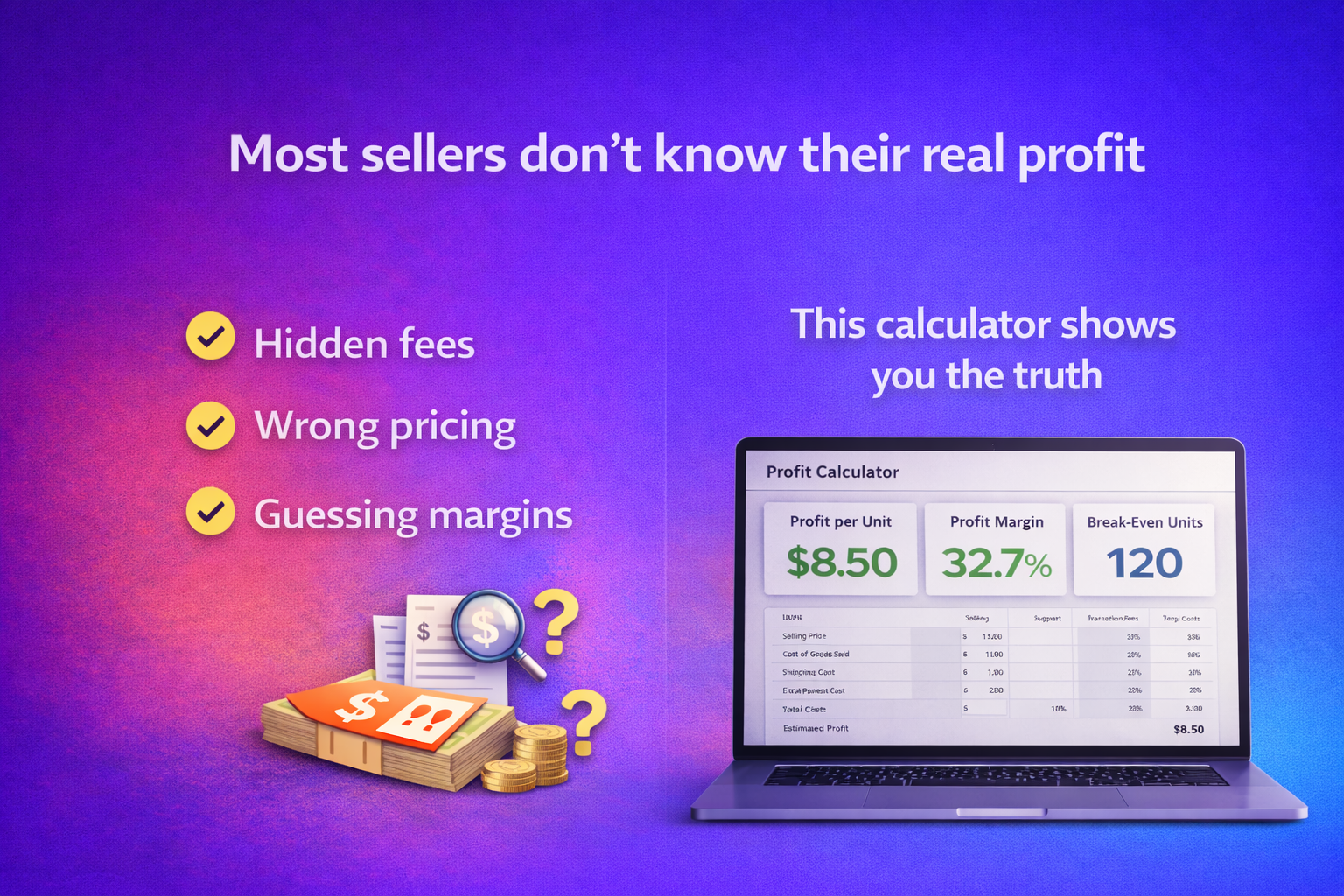
The Product Profit Calculator has a built-in break-even tab — you enter your costs and it calculates break-even units and timeline automatically. Change any input to model different scenarios before you commit.
Break-even vs. profitability: the difference that matters
Break-even tells you when you stop losing money.
It doesn’t tell you when the business is profitable enough to sustain itself.
After break-even, the next milestone to calculate: time-to-viable — when your monthly profit from the product covers your time investment at a rate you’d actually accept.
If it takes 6 hours per month to run the product (listings, orders, customer service) and you want to earn $20/hour minimum, you need $120/month in profit before this is worth continuing.
At $14.44 margin per unit, that’s 9 units per month. A manageable target for most niches once you have reviews.
Run both numbers. Break-even tells you whether to launch. Time-to-viable tells you whether to continue.
The profit margin and break-even spreadsheet handles both calculations in one place — enter your costs once and both numbers update instantly.
People also ask
How do I calculate my break-even point on Etsy?
Divide your total fixed launch costs by your contribution margin per unit. Contribution margin = Sale Price − Variable Costs (materials + packaging + carrier shipping + Etsy’s full fee stack of ~10% + $0.20). The result is the number of units you need to sell before you’re in profit.
What is a good break-even number for an Etsy shop?
Under 20 units for a typical new product is solid — achievable within your first 30–60 days with good listing optimization. Over 50 units is a signal to review your cost structure or reduce launch spend. Over 100 units before you break even means the economics need work before you scale.
How long does it take to break even on Etsy?
New Etsy shops without existing social media or email traffic typically reach consistent daily sales after 60–90 days. With Etsy Ads budget, this can compress to 30–45 days. A 20-unit break-even in 30 days requires roughly 1 sale every 1.5 days — realistic for a well-photographed product in a niche with search volume.
Do I include Etsy Ads in my break-even calculation?
Include Etsy Ads budget as a fixed launch cost if you plan to run ads at launch. This increases your break-even unit count but reflects reality. If ads are ongoing (not just at launch), calculate your average cost per sale from ads and add it as a variable cost instead.
What is the difference between break-even and profit margin?
Break-even tells you the sales volume where total revenue equals total costs. Profit margin tells you the percentage of each sale that becomes profit after costs. Both are necessary: break-even answers “when do I stop losing money?” and margin answers “how much does each sale earn once I’m past break-even?”
From this article
Ecommerce & Sellers
Product Profit Calculator
Most products don't fail because they don't sell. They fail because they're not profitable. Know your real numbers before you launch.