How Much Are You Really Spending on Coffee?
Most people guess they spend $300/year on coffee. The real number is 3–5x higher. Here's the exact math — and what that money could become instead.
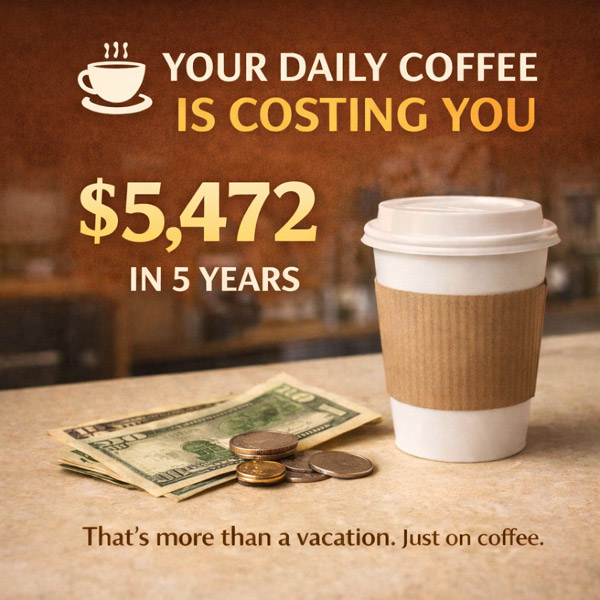
TL;DR: At $3.50 per coffee twice a day, you are spending $2,555 per year. Most people estimate their coffee habit at $300/year — the real number is 3–5× higher. The goal is not to stop drinking coffee. It is to know the actual cost before deciding whether it is worth it.
Most people think coffee is a $3–$5 habit.
It’s not.
It’s one of the most expensive invisible expenses in your life. And most people have no idea what it’s actually costing them until they sit down and run the numbers.
How much does buying coffee every day cost per year?
The short answer:
- 1 coffee/day at $3.50 → $1,278/year
- 2 coffees/day at $3.50 → $2,555/year
- 2 coffees/day at $5.00 → $3,650/year
Over 5 years, 2 coffees/day at $3.50 = $12,775.
That’s not a rounding error. That’s a decent vacation, a used car, or a year of compound growth in an index fund.
Most people — when asked — estimate they spend $300/year on coffee. The real number is usually 3–5x that.
Why small daily costs are so hard to feel
Each coffee is $3.50. That doesn’t feel like money.
That’s the problem.
Small, frequent purchases don’t trigger the same financial awareness as a $500 expense. You wouldn’t pay $500 for something without thinking about it. But $3.50? No friction at all.
This is what personal finance researchers call invisible spending — small recurring costs that accumulate into large amounts without ever feeling significant. Coffee is the clearest example: the individual purchase is trivial, but the pattern is expensive.
You don’t need to stop drinking coffee. You need to know the number.
What your daily coffee habit actually costs
This table covers the most common scenarios. Find yours.
| Coffees/day | Cost per coffee | Weekly | Monthly | Yearly | 5 years |
|---|---|---|---|---|---|
| 1 | $2.50 | $17.50 | $75 | $913 | $4,563 |
| 1 | $3.50 | $24.50 | $106 | $1,278 | $6,388 |
| 2 | $3.50 | $49.00 | $213 | $2,555 | $12,775 |
| 2 | $5.00 | $70.00 | $304 | $3,650 | $18,250 |
| 3 | $3.50 | $73.50 | $319 | $3,833 | $19,163 |
Assumes 7 days/week. Adjust for your actual pattern.
Most people land in the second or third row. Both add up to more than they expected.
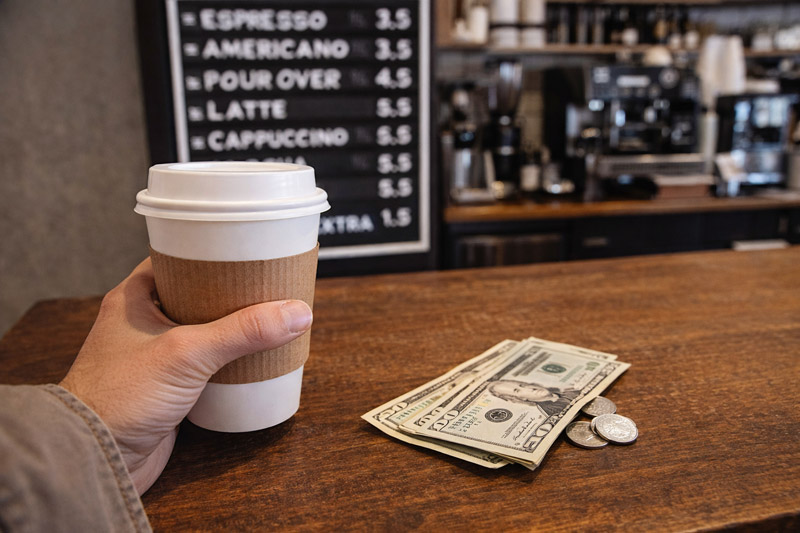
What if you invested that money instead?
Here’s where the number gets uncomfortable.
At a 5% average annual return — conservative for a basic index fund — here’s what your coffee savings would grow to over 5 years if redirected:
| Monthly savings | 5 years (5% return) | 10 years |
|---|---|---|
| $75/month (1 coffee/day at $2.50) | ~$5,100 | ~$11,600 |
| $106/month (1 coffee/day at $3.50) | ~$7,200 | ~$16,500 |
| $213/month (2 coffees/day at $3.50) | ~$14,500 | ~$33,100 |
| $304/month (2 coffees/day at $5.00) | ~$20,700 | ~$47,300 |
Nobody is saying cut all coffee. But seeing these numbers changes how the $3.50 feels.
The goal isn’t to make you feel bad. It’s to make the cost visible — so you can decide with actual information instead of a vague sense that “it’s not that much.”
If you want to skip building this yourself, the Coffee Spending Tracker for Excel does all of this automatically. Enter 3 numbers — cost per coffee, coffees per day, days per week — and it calculates your real spending, your savings potential at 25/50/100% reduction, and the 5-year compound growth projection. $0.99, instant download.
BravePicks: The most common adjustment after calculating the real annual number is not cutting coffee entirely — it is cutting from 2 per day to 1, or switching to home brew one day a week. Small changes, but they save $600–$1,200 per year.
The three decisions people make after seeing the number
Once you know the real cost, you’re in one of three places:
Option 1 — Cut completely. Some people see the number and immediately switch to home coffee. At $0.20–$0.40 a cup, the yearly cost drops from $2,000+ to under $200.
Option 2 — Cut partially. Keep the coffee but reduce frequency. Cut from 2 coffees/day to 1, or from 7 days/week to 5. You save $600–$1,200/year and still have coffee.
Option 3 — Keep it and move on. If you’ve run the numbers and you’re fine with the cost, you’ve made an informed decision. That’s the point. Invisible spending is the problem — conscious spending is fine.
Most people who do this exercise end up somewhere between option 1 and 2. The adjustment is small. The savings are real.
This pattern — invisible spending adding up to thousands — isn’t unique to coffee. If you want to apply the same logic to your subscriptions, this subscription spending audit spreadsheet walks through the same process for recurring charges.
And if you want a single place to track all of it, the budget tracker template covers income, expenses, and savings in one spreadsheet — so you can see where everything is going, not just the coffee.
People also ask
How much does a daily coffee habit cost per year?
At $3.50 per coffee once a day, that’s $1,278/year. Twice a day brings it to $2,555. Over 5 years, a 2-coffee-per-day habit at $3.50 each costs $12,775. Most people underestimate this by 3x or more because the daily cost feels small.
Is buying coffee every day worth it?
That depends on what you’re comparing it to. The cost itself isn’t inherently bad — but most people don’t know the actual number. Once you calculate the yearly total and what it would look like invested over 5 years, you can make a real decision. Use the Coffee Spending Tracker to run your specific numbers in under a minute.
What is the cheapest way to reduce coffee spending?
Making coffee at home is the biggest lever. A home brew costs $0.20–$0.40 per cup vs. $3–$6 at a café. If you can’t give up café coffee entirely, cutting from 2 per day to 1 saves roughly $100–$150/month without eliminating the habit.
How do I calculate my real coffee spending?
Multiply your cost per coffee × coffees per day × 7 × 52. Example: $3.50 × 2 × 7 × 52 = $2,548/year. Or use a coffee habit cost calculator that does this automatically and also shows you savings scenarios and compound growth projections.
What is “invisible spending” in personal finance?
Invisible spending refers to small, frequent costs that don’t trigger financial awareness because each individual transaction feels trivial. Daily coffee, streaming subscriptions, and convenience purchases are the most common categories. The issue isn’t any single purchase — it’s the annual total you’ve never actually seen.
From this article
Personal Finance
Coffee Spending Tracker
Find out exactly how much your daily coffee habit costs you — and what you could do with that money instead.