How to Price Your Etsy Product (The Exact Formula)
Pricing by feel on Etsy means discovering the margin problem after you've sold 100 units. Here's the exact formula — plus the fee math most sellers miss.
Ecommerce & Sellers → How to Calculate Your Product Profit Margin → How to Price Your Etsy Product (you’re here) → Break-Even Calculator for Etsy Sellers
TL;DR: Etsy pricing formula: (Materials + Labor + Overhead) ÷ (1 − Target Margin %) = minimum viable price. Then add $0.20 listing fee and verify that 9.5–10% of the final price still leaves you the margin you need. Most sellers price by feel and discover the problem at 100 units sold.
She found a comparable product on Etsy for $18.
She priced hers at $16.
Sold out in two weeks. Orders kept coming. She scaled up.
Three months later she sat down to calculate what she’d actually earned. After materials, shipping, Etsy fees, and packaging, her margin was 11%. She was essentially working for $1.20 an hour.
The product worked. The price didn’t.
This is the most common story in Etsy seller forums. The fix is running the math before you commit the inventory.
Why Etsy pricing fails even when you “do the math”
Most sellers do some version of the math. The problem is what they leave out.
They use one Etsy fee instead of all of them. Etsy’s 6.5% transaction fee is the one sellers remember. But there’s also a $0.20 listing fee per item and about 3% payment processing. Stacked together, Etsy takes roughly 10–12% of your sale price on every transaction — not 6.5%.
They forget shipping. Sellers who offer free shipping to improve conversion often absorb $4–$8 per order in carrier costs. That’s the margin. Gone.
They don’t account for their time. For handmade products, labor is usually the largest cost. Leaving it out means the math looks fine while you’re actually earning less than minimum wage.
They price off competitors without knowing their competitor’s cost structure. A shop selling at $14 might have lower supplier costs, be in a different country, or be running at near-zero margin to build reviews. Their price is not your floor.
| What sellers include | What sellers forget |
|---|---|
| Materials | Etsy listing fee ($0.20/item) |
| Headline transaction fee (6.5%) | Payment processing (~3%) |
| Shipping cost to buyer | Carrier cost you absorb on free shipping |
| — | Packaging materials |
| — | Labor (for handmade) |
| — | Return rate (~2–3%) |
BravePicks: When fully stacked — listing fee, 6.5% transaction fee, and ~3% payment processing — Etsy fees represent 10–12% of the sale price on a typical $25 item, not the 6.5% most sellers cite when doing margin math.
The exact Etsy pricing formula
Step 1 — Calculate your total cost per unit
Total Cost = Materials + Packaging + Shipping (carrier cost) + LaborStep 2 — Add Etsy fees
Etsy Fees = $0.20 + (Sale Price × 0.065) + (Sale Price × 0.03)
           = $0.20 + (Sale Price × 0.095)
Since your fees depend on your sale price, the simplest approach: assume Etsy takes 10% of your sale price and $0.20.
Step 3 — Solve for your minimum viable price
Minimum Price = Total Cost ÷ (1 − 0.10 − Target Margin %)Example with a 40% target margin:
- Materials: $5.00
- Packaging: $1.50
- Shipping (carrier): $4.50
- Labor (20 min at $20/hr): $6.67
- Total cost: $17.67
- Minimum price = $17.67 ÷ (1 − 0.10 − 0.40) = $35.34
At $35, you hit your 40% margin after all Etsy fees. At $28, you’re at 20% — which sounds OK until you have a bad month with returns and shipping delays.
Etsy pricing benchmarks by category
Research your category before you finalize. Here’s what typical price ranges look like across common Etsy segments:
| Category | Typical price range | Avg materials cost | BravePicks verdict |
|---|---|---|---|
| Printable art / digital downloads | $3–$15 | $0 | Best margin on Etsy — no shipping or materials |
| Handmade jewelry | $15–$65 | $3–$15 | Mid-range ($25–$45) converts best in most niches |
| Handmade candles | $12–$35 | $3–$8 | Competitive — differentiate on packaging and branding |
| Custom pet portraits | $25–$80 | $2–$10 | Premium pricing justified by personalization |
| Knit / crochet items | $20–$80 | $5–$20 | Labor-intensive — price must reflect time or margin disappears |
| Printable templates | $5–$25 | $0 | High margin, high volume potential |
The “Typical price range” reflects what actual bestsellers in each category charge, not what the cheapest listings show.
The pricing mistakes that kill Etsy shops
Starting too low to “build reviews.” Low prices attract price-sensitive buyers who often leave neutral reviews when they compare your product to a $40 version. You sacrifice margin AND you don’t build the social proof you wanted. Better: price correctly from day one, use photography and shop branding to justify it.
Not testing price elasticity. If you’re selling 40 units a month at $18, try $22 for 60 days. You might sell 30 units — but your revenue goes up and your time per dollar goes down. Some niches have more pricing power than sellers realize.
Seasonal pricing without margin review. Many sellers discount during slow months without checking whether the discounted price is still profitable after fees.
Ignoring Etsy Ads math. If you run Etsy Ads, the platform charges an additional 12–15% offsite ad fee on qualifying sales. Build that into your price — or your ads will eat your margin.
When your cost structure doesn’t work at market price
Sometimes you run the math and your minimum viable price is $38, but the market for your product tops out at $25.
This is important information. It means one of three things:
- Your costs need to come down — better supplier, smaller packaging, batch production
- The product isn’t viable on Etsy — economics don’t work at current costs
- You need to differentiate — custom options, personalization, or premium positioning that justifies a price above the category average
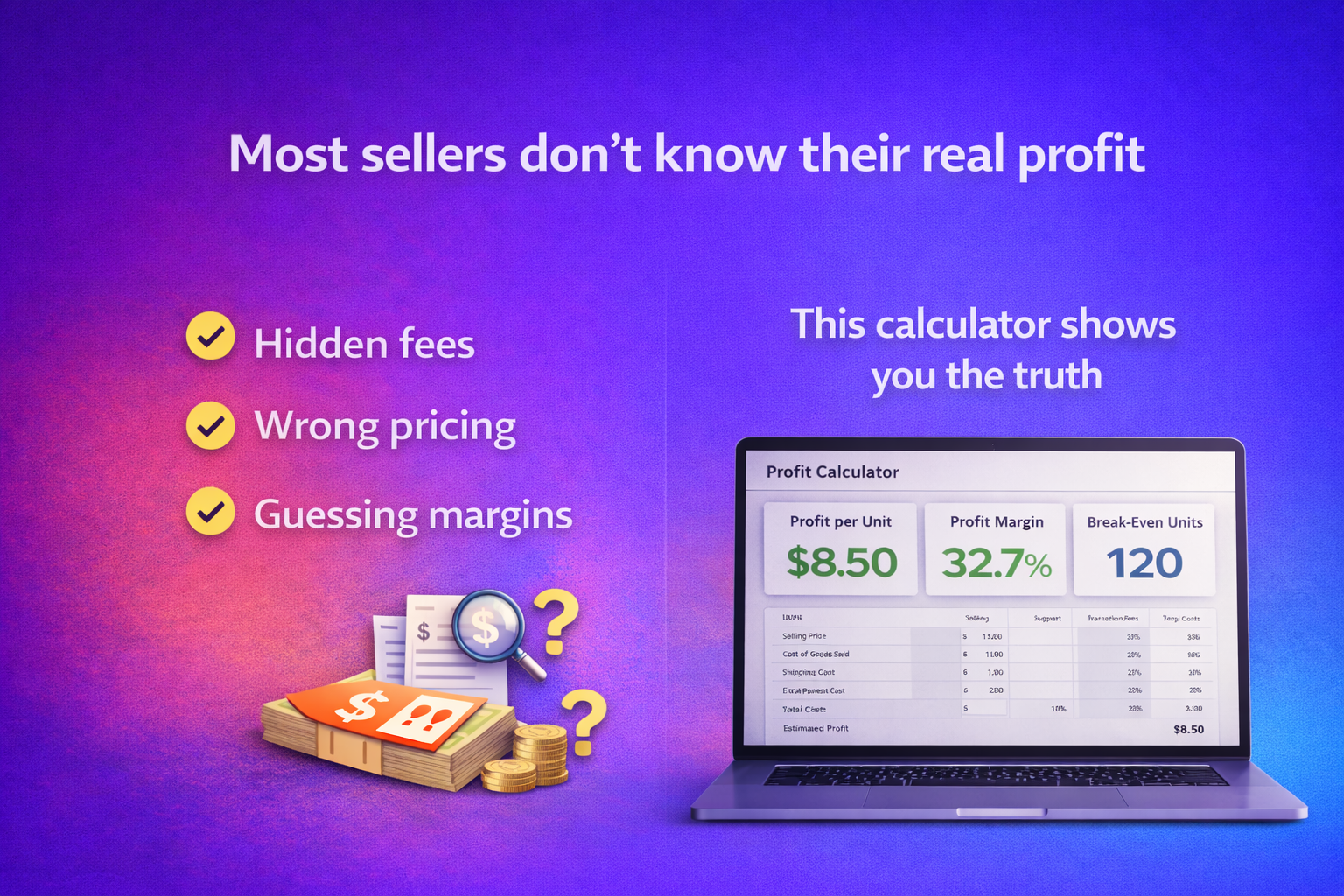
The Product Profit Calculator runs these scenarios instantly — change any input and see how margin shifts, so you can find the price that actually works before committing inventory.
People also ask
How do I price my Etsy products?
Start with your total cost per unit — materials, packaging, carrier shipping cost, and labor for handmade items. Divide by (1 − Etsy fees % − Target margin %). For a 40% target margin with 10% Etsy fees: divide total cost by 0.50. That’s your floor price. Then check where competitors in your category are priced to confirm the market will bear it.
What percentage does Etsy take from each sale?
Etsy’s fees stack: $0.20 listing fee per item, 6.5% transaction fee, and ~3% payment processing. Combined, that’s 9.5–10% of your sale price plus $0.20 per transaction. If you’re opted into Etsy Ads, offsite ad fees add 12–15% on qualifying sales, which reduces margin significantly on ad-driven revenue.
Is $5 profit per item good on Etsy?
Depends on the price point and your volume. $5 profit on a $12 item is 42% margin — solid. $5 profit on a $30 item is 17% margin — too thin. One bad month with returns, damaged stock, or a shipping increase and you’re near zero. The number that matters is your margin percentage, not the dollar amount.
How do I compete with cheaper Etsy sellers without lowering my price?
Compete on signal quality, not price. Improve your product photography (the biggest single conversion driver on Etsy). Get your first 10 reviews with a focused launch. Write listings that explain your materials and process in detail — buyers who want cheap will filter themselves out, and buyers who care about quality will pay more.
Should I offer free shipping on Etsy?
Free shipping improves conversion and Etsy’s search algorithm favors it. But only offer it if you’ve absorbed the shipping cost into your price first. Calculate your average shipping cost by zone, add it to your product price, then turn on free shipping. If your product is light and ships domestically, this is usually worth it. For heavy or international orders, the math often doesn’t work.
From this article
Ecommerce & Sellers
Product Profit Calculator
Most products don't fail because they don't sell. They fail because they're not profitable. Know your real numbers before you launch.