Your Daily Matcha Is Costing You Thousands — Here's the Real Math
A daily matcha costs more than it looks. Here's the breakdown: yearly spend, hours worked to pay for it, and what that money becomes if invested instead.
Personal Finance → How Much Are You Really Spending on Coffee? → How Much Am I Really Spending on Subscriptions? → How to Cut Monthly Expenses Fast → Your Daily Matcha Is Costing You Thousands (you’re here)
TL;DR: At $7 per day, a daily matcha habit costs $2,555 per year — and more than $12,000 in investment opportunity cost over five years. At a $20/hour wage, you work over 400 hours just to pay for it. The number isn’t meant to make you feel bad. It’s meant to make the cost visible so you can decide whether it’s worth it.
You’re not buying matcha.
You’re trading hours of your life for it.
That reframe is uncomfortable — but it’s accurate. Every $7 matcha represents 21 minutes of work at a $20/hour salary. Buy one daily for five years and you’ve worked more than 400 hours specifically to fund that habit.
The dollar amount is one way to see it. The time cost is another. The investment opportunity cost is the third — and it’s the number most people never calculate.
Here’s all three.
How much does a daily matcha habit cost per year?
The math most people avoid running:
| Price per matcha | Frequency | Weekly | Monthly | Yearly | 5 years |
|---|---|---|---|---|---|
| $5.00 | Daily | $35 | $152 | $1,825 | $9,125 |
| $7.00 | Daily | $49 | $213 | $2,555 | $12,775 |
| $9.00 | Daily | $63 | $274 | $3,285 | $16,425 |
| $7.00 | 5×/week | $35 | $152 | $1,820 | $9,100 |
| $7.00 | 3×/week | $21 | $91 | $1,092 | $5,460 |
Most people mentally round a $7 purchase to “basically nothing.” At daily frequency, it is $213 a month — the same category as a gym membership, a streaming bundle, or a utility bill.
The individual purchase doesn’t feel significant. The pattern is expensive.
The time cost: how many hours do you work to pay for matcha?
Money is abstract. Time is not.
At a $20/hour wage:
| Price per matcha | Cost in minutes worked | Hours per year | Hours over 5 years |
|---|---|---|---|
| $5.00 | 15 min | 91 hours | 456 hours |
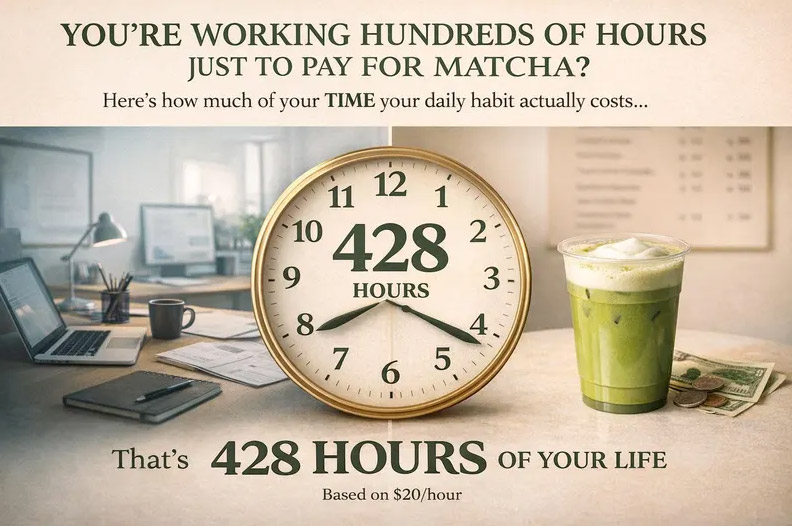
| $7.00 | 21 min | 128 hours | 428 hours |
| $9.00 | 27 min | 164 hours | 821 hours |
428 hours. That’s over 10 weeks of full-time work, spent earning money for a single daily habit.
This number tends to land harder than the dollar figure because hours are finite in a way dollars are not. You can always earn more money. You cannot get back more time.
The calculation changes at different wage levels — which is exactly what the Matcha Habit Cost Calculator lets you model. Enter your actual hourly rate and see your specific number.
BravePicks: The most common reaction after running the time cost calculation: not guilt, but recalibration. Most people do not stop buying matcha — they shift from daily to 4–5 times per week. That single change recovers 80–100 hours per year.
The opportunity cost: what that money could become instead
This is the number most people never see.
If you redirected your daily matcha spending into an index fund instead, here’s what it could grow to over time at a 7% average annual return:
| Monthly savings redirected | 5 years | 10 years | 20 years |
|---|---|---|---|
| $152/month ($5 daily matcha) | ~$10,600 | ~$26,300 | ~$78,700 |
| $213/month ($7 daily matcha) | ~$15,100 | ~$37,000 | ~$110,900 |
| $274/month ($9 daily matcha) | ~$19,100 | ~$47,400 | ~$142,400 |
At $7/day, a daily matcha habit costs over $12,000 in investment opportunity over five years.
Over twenty years, it’s over $110,000.
This is what personal finance calls opportunity cost — not just what you spend, but what that money would have become. The habit doesn’t just cost $2,555 per year. It costs the future value of $2,555 per year, compounded forward.
None of this means you should stop drinking matcha. It means you should decide whether you want to with full information.
Three ways to respond to these numbers
Once you know the real cost, you have three options:
Option 1 — Cut completely. Switch to home matcha ($1–2 per serving versus $7 at a café). Annual cost drops from $2,555 to $365–730. The quality difference is real but most people adjust quickly.
Option 2 — Cut frequency. Keep the café matcha but reduce from daily to 3–4 times per week. You recover 60–70% of the financial impact while keeping most of the habit. This is the most common outcome after running the numbers.
Option 3 — Keep it and move on. If you’ve seen the full cost and you’re comfortable with it — the matcha is worth $213/month to you, and it fits your budget — then it’s a conscious choice. That is the goal. Not guilt. Not deprivation. Visibility.
Most people who run the numbers end up at option 2. The adjustment is small. The savings compound forward.
If you want to see your specific numbers — your price, your frequency, your hourly rate, your time horizon — the Matcha Habit Cost Calculator does all three calculations automatically. Enter 5 inputs, get instant output: yearly cost, hours worked, investment opportunity. $0.99, one-time download.
The same logic applies to any daily habit. If you want to run the same analysis on coffee, the Coffee Spending Tracker works the same way.
BravePicks: The most actionable insight from running these calculations is not the 5-year total — it is the monthly number. Seeing $213/month on a single habit reframes it instantly. Monthly figures are how budgets are built and how financial trade-offs get made.
People also ask
How much does a daily matcha habit cost per year?
At $7 per matcha every day, that’s $2,555 per year. At $9 — which is common at specialty cafés — it’s $3,285. Over five years, a daily $7 matcha habit totals $12,775. Most people estimate their matcha spending at a fraction of this because the daily cost feels too small to add up to anything significant.
How many hours do you work just to pay for matcha?
At a $20/hour wage and $7 per matcha, each drink costs you 21 minutes of work. Daily for five years, that’s over 428 hours — more than 10 full working weeks — spent earning money specifically to buy matcha. This time-cost framing is often more striking than the dollar amount.
What is the opportunity cost of a daily matcha habit?
If you invested $213/month (the cost of a daily $7 matcha) at 7% annual return instead of spending it, after five years you’d have approximately $15,100 — after ten years, roughly $37,000. The opportunity cost is the difference between what you spent and what it would have become invested. That’s what the habit really costs over a longer time horizon.
Is making matcha at home worth it financially?
Yes — significantly. Home-brewed matcha typically costs $1–2 per serving versus $6–9 at a café. Switching home saves $1,800–2,500 per year for a daily habit. Some people switch entirely. Others keep café matcha as an occasional treat and brew at home the rest of the time. The financial difference is substantial either way.
What is the latte factor in personal finance?
The latte factor is a concept from personal finance author David Bach describing how small daily purchases — coffee, matcha, lunches — accumulate into significant annual spending that most people never consciously account for. The argument is not that small pleasures are bad but that making them visible allows you to choose them intentionally rather than spending on autopilot. This calculator applies the same logic to matcha specifically.
From this article
Personal Finance
Matcha Habit Cost Calculator
Most people don't have a spending problem. They have a visibility problem. This template fixes that in seconds.